Wiki › Homes and land
Homes and land
Ground of your own under the hills, and a house in it with walls, a table to eat at and a bed to sleep in.
Why nobody holds the surface
By the Edict of Ash the open land is the towns' and the road's, never a person's. The first Wardens wrote it after the Burning: Aurel's ring of iron was a claim on the surface, and it burned the city; what lies under the sky is watched from above, and what is watched and claimed is unmade. Stone is too patient for the Wane: an ember carried down and set in stone keeps a hold. So land is claimed below the ground. (The story of it is Chapter III: Below the Well.)
Builds under the open sky still fade after 2 hours when nobody holds them, as they always have.
The healing skin
The open land heals over its holes. A tile of the top three rows of natural ground (the grass, dirt, sand, snow and stone the land was made of) that was dug, blown up or burnt away grows back after 5 minutes, as it was, when:
- nobody is within 12 columns of it, at any depth (so it never closes over someone working below it), and it waits 30 seconds after the last one walks away;
- no Grown and no dropped item is in it.
Only open air grows back. A ladder, a block, a torch, a door or water in the top rows keeps a shaft open: one ladder at the top keeps your way down for as long as you like. A hole left bare closes, so nobody new falls into it.
Nor does it close what you built. A hole under a block or a ladder you put over it (nobody can fall in), the two tiles on top of an elevator block (where you land), and the room emberwork needs to work in (any part of it within two tiles: a ram's travel, a drop-floor's pit) stay open as long as those are there. Take them away and the hole grows back 5 minutes later, like any other.
It is the same in the open world and in the hunting grounds, but not on a Home's land or an old plot, nor in towns, on the land a town grows back round it (that land heals everything already), in dungeons, in the Skyreach or on the mountains at the end of a hunting ground. Holes dug before the skin came are found as their land is next walked to, and their 5 minutes start then.
A tile that grew back gives no finds (seeds, gold, lost pages, grubs) if it is dug again within 30 minutes: digging the same hole over and over pays only the dirt. What the tile itself gives (the dirt, sand or stone) comes as ever.
Setting down a Home Stone
- Craft a Land deed at a Workbench: 10 planks, 2 iron bars and 50 gold.
- Dig down. Hold the deed and point at a spot within reach: the page draws the land the Home Stone would hold, green where it can go and red where it cannot, with the reason over it. Right click, then press Set it down.
- The deed becomes a Home Stone, a stone with a sliver of ember in it, and the ground around it, a square 17 tiles a side (8 every way from the stone, corners and all), is its land. The stone and its land are your Home.
- On its land only you (all your characters), your group and your guild may dig, build or harvest, and friends too if you let them (Friends may build, on the map). Nothing you build there fades. Doors and back walls there are safe too, and no stranger's bomb, siege or digging Grown breaks anything on it. (The one exception is a Home raid: see below.)
- While the Home Stone is lit no Grown are born on its land and no lair's great one wakes on it. Lit or cold, lava and water from outside stop at its edge, and what is inside flows inside only, and no fire burns on it: lava beside your wooden walls there leaves them be (see Fire and fluids).
- Emberwork on its land never fades (up to 400 parts). Visitors may step on your plates and pull your levers and cords (those only in plain sight, never through a wall), and a door with wire at it opens for whoever warms its wire: keep the lever of your own door inside your walls (see Emberwork).
- Visitors lose nothing: anyone not of your Home who falls on your land keeps their gold and their trade pack and drops nothing; an outlaw still pays (see Death and waking up).
- An account holds up to 5 Homes between its characters.
Where a Home Stone can go
- Every tile of its land at least 4 rows below the surface of its own column ("Too near the surface here").
- Not under the open sky ("Not under the open sky: the Edict of Ash").
- Not within 24 columns of a town or port, nor on the land a town grows back around it, unless its whole land lies more than 40 rows under the town's street (see Under the towns, below). Deep enough, a Home may go right under a town.
- Not in the Skyreach, not in a dungeon, not near an open rift.
- Not touching another Home's land ("Its land would touch another Home's land"): side by side or corner to corner. A tile of rock between the two squares is enough. A guildmate's Home is the exception: see Partners and joined Homes.
- Never overlapping another Home's land, a guildmate's included.
Under the towns
A town's ground goes down 8 rows under its street: the 6 rows of dirt every town stands on, and 2 more. The same holds for every port and for each hunting ground's camp. In that ground nothing has changed: nobody digs or builds, no Grown is born there or comes in (not even up a shaft from below), nobody is hurt and nobody fights, and no lava, water, fire or blast gets in. Trying says so: Towns and ports are protected, down to 8 rows under the street.
Below that line the land under a town is ordinary land, as anywhere else: dig, build and mine there; Grown may be born in its caves and come for you; lava, water, fire, bombs and machines keep their usual rules; and so do the rules of PvP. What you build there fades after 2 hours like anything on open ground, unless a Home holds it. The town keeps you safe only while all of you is in its ground: stand with your feet below the line and you are on ordinary land, whatever row your head is in.
A Home under the city: a Home Stone may be set down under a town, or under the land round it that the town grows back, when its whole land lies more than 40 rows under the street. The town grows nothing back on a Home's land for as long as the Home is there: build on it as on any Home's land, chests and doors too. Give the Home up and the land there grows back as it does all round the town.
Widening its land
An ember core (at a Furnace: a mythril bar, a crystal, 3 essence and 2 charcoal) widens a Home's land. Hold it and right click your Home Stone:
| Tier | Its land | Takes |
|---|---|---|
| 1 | a square 17 a side (8 from the stone) | the deed |
| 2 | a square 25 a side (12 from the stone) | 1 ember core |
| 3 | a square 33 a side (16 from the stone) | 3 more ember cores |
The wider land has to fit the same rules (deep enough, touching no other Home); if it does not, the core stays in your bag and you are told why. A second ember core recipe takes Wane-amber from Home raids (at a Furnace: 6 Wane-amber, 2 iron bars and 2 charcoal). The Founding Ember of Chapter III widens a Home's land to tier 2 without a core.
Keeping a Home
A Home is not forever. Its Home Stone keeps its land only while it is kept.
The keep. Every Home Stone has a keep: a store of crafting materials. Right click your Home Stone (or press Keep… on the map) to see it: how many days it is kept, what a day costs, and what is in it. Choose how many days to put in, from 1 to 30 (type it, step it, or touch 1, 7, 14 or 30), and Put in moves that many days' worth from your bag: as many as you carry, and as many as the keep has room for (it holds 30 days' worth). Anyone of the Home (you, your other characters, your group and guild, friends you let build) can put in, standing on its land. Each day the Home pays its upkeep from the keep:
| Tier | Its land | A day's upkeep |
|---|---|---|
| 1 | 17 a side | 20 Stone, 10 Planks |
| 2 | 25 a side | 40 Stone, 20 Planks, 4 Iron bars |
| 3 | 33 a side | 60 Stone, 30 Planks, 8 Iron bars, 2 Mythril bars |
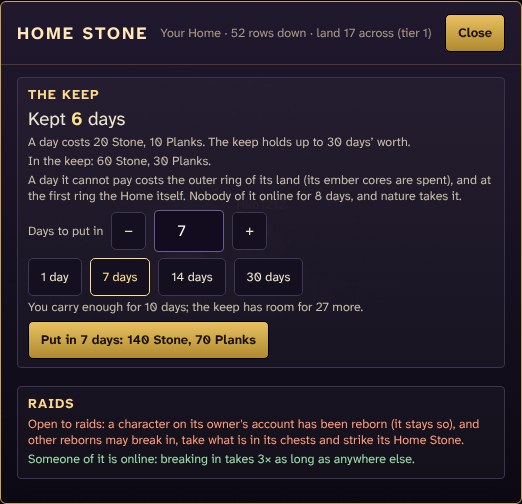
The keep holds up to 30 days' worth of each. Widening a Home raises its upkeep: the Stone says so, and the first day at the new tier is free. Give a Home up (or put its Stone out) and what is in its keep comes back to you. A new Home starts with 3 days kept; Homes from before the keep started with 7, free, and a letter.
A day it cannot pay costs the outer ring. The Home drops a tier and its land shrinks to the smaller square. What was built in the ring it lost fades 2 hours later, as anything on open ground does, and the ember cores that widened it are spent: widening it again takes new ones. At the first tier, a day it cannot pay costs the Home itself. Each loss comes with a letter.
Nature takes a Home left alone. If nobody of the Home comes online for 8 days, nature takes it: the Home Stone goes out, what was built there fades 2 hours later, and the deed comes back to you by letter. Letters warn you at 5 days ("in 3 days") and at 7 ("tomorrow"). Anyone of the Home logging in keeps it.
Raids between reborns
Once you are reborn, every Home of your account, on any character, can be raided by other reborns. The rebirth window says so. It is the account that counts: a Home owned by a fresh character of an account that has a reborn character is open to raids too, and a Home once open to raids stays so. A Home of an account that never had a reborn character is never raided by players.
A raider (a reborn who is not of the Home) may, on its land:
- break in: break blocks, walls and doors (never put anything there). Breaking a block takes 3× as long as anywhere else while anyone of the Home is online, and 15× as long while nobody of it is;
- loot: open its chests and take what is in them, standing on its land with the chest in plain sight;
- strike its Home Stone, only while someone of the Home is online. The Stone has the raid life it has against the Grown (800 a tier), and a strike takes at most a fortieth of it, so it takes forty strikes at the least. At nothing the Home falls: its claim ends, the deed goes back to its owner by letter, what was built there fades in 2 hours, and the whole world hears of it.
When a raid starts, everyone of the Home online is told at once, and its alarm bells ring. While the raid is on (the raider broke something or opened a chest there in the last 5 minutes), the raider and the Home's people can fight each other inside its land, PvP or not, with no marks and no murder. The Home's spikes hurt the raider standing on them and its loaded ballistas shoot them, as they do the Grown. Five quiet minutes after the last thing broken, the owner gets a letter: who broke in, how many blocks and chests, and what was taken.
The best defence is a Home that is lived in: iron gates and Ironbound blocks are slow to break even for a reborn, and while nobody of the Home is online its Stone cannot be struck at all.
Defending it
A Home less than 40 rows below the ground is never raided. Deeper down, it draws the Grown: while you (or anyone of the Home) are near, they come in waves and claw their way towards it. Hold it and a raid chest pays you in Wane-amber; lose and it goes cold for 30 minutes. Your claim and your builds stay either way. On its land the raiders dig through ordinary blocks, never Home brick, Ironbound blocks, iron gates, chests, stations, beds or emberwork. All of it, and the defences you can build, is in Home raids and defence; with emberwire your spikes can wait sunk in the floor until the raiders come (see Emberwork).
Seeing land
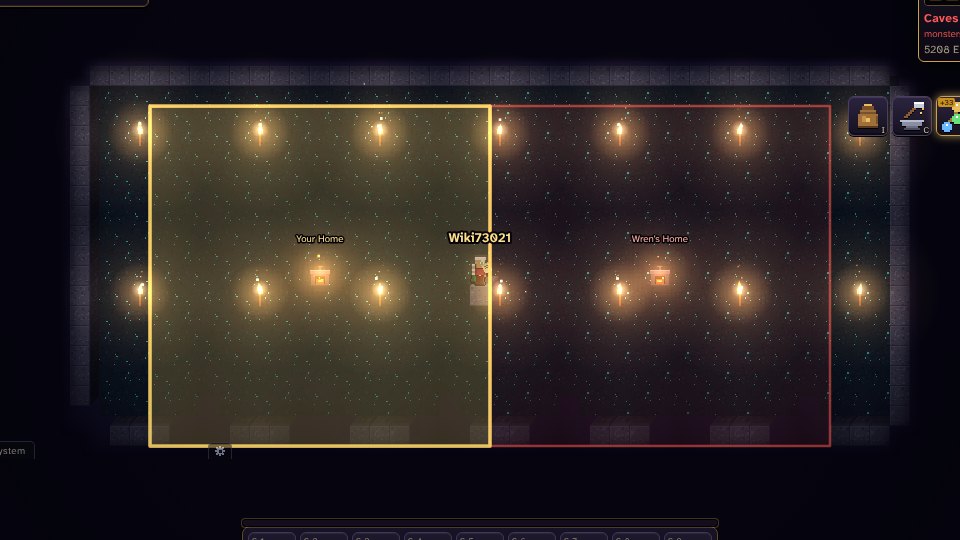
- Every Home Stone glows in the rock. Holding a deed shows every Home's land: gold where you may build (yours, your group's, your guild's, or a friend's who lets you), red where you may not. Without a deed they show faintly.
- Walking onto a Home's land tells you whose Home it is, how deep it lies, and who may build there. The line under the minimap says it too.
- The minimap outlines each Home's land as its square; the world map (M) flags each Home, with how deep it lies.
- Travellers are never walled in: someone who pushes against a wall on your land is guided through to the first place past its edge. Someone travelling to a group member who stands on your land arrives at its edge too, unless they may build there (your group, your guild, or a friend you let in): then beside the member.
Partners and joined Homes
A Home can be shared with your guild in two ways.
Partners. On the map (M), under Your Homes, each Home has a Partners box: name up to 4 partners, all of them in your guild. A partner may build, dig and harvest there, open its chests as you can and put into its keep, and is warned when it is raided; their map lists the Home under Homes you share. A partner cannot give the Home up, widen it or name partners. Someone who leaves the guild stops being a partner at once.
Joined Homes. A guildmate may set a Home Stone so that its square touches yours: side by side, sharing an edge or a corner, never overlapping. The two are then joined, up to 4 Homes together: every owner in the group is a partner of every Home in it, and they read as one block of land on the map and in the rock. Widening a joined Home may make it touch others of its group, never overlap them. An owner who leaves the guild takes their Home out of the group: it stays where it is, but no longer shares anything. Each Home still counts toward its own account's 3.
Your Homes on the map
The map (M) lists your Homes under Your Homes: how deep, how wide (its tier), its heat, where it is, how many days it is kept and whether it is open to raids, and three buttons:
- Friends may build: your friends (people who accepted your friend request) may build, dig and harvest there too. Off to start with.
- Keep…: opens the Home Stone's window: the days kept, a day's upkeep, and Put in (see Keeping a Home).
- Give it up: click it twice. The Home Stone goes out and your Land deed comes back to you. What you built stays, but anyone may break it, and it fades 2 hours later, as anything on open ground does.
Digging your own Home Stone with a pick asks you first, and then does the same (the deed drops at your feet). Nobody else can break it.
The old plots
Plots claimed before the Edict (12 columns, from the sky down) lapse: each keeps its protection for 7 days after the update, its owner gets a letter explaining the Edict, and on the day it lapses the deed comes back by letter (if the letter cannot go, the deed is in your bag at your next login). Until then the map lists it under Your Homes as an old plot, with the day it lapses and a Give it up now button. An old plot does not count against your 5 Homes, and nobody can set down a Home Stone on its columns until it lapses. When it lapses (or you give it up early), what is built there, before the Edict or since, fades 2 hours later, like anything else on open ground. Move what you want to keep onto a Home's land before then.
A guild hall
The guild leader makes one of their own Homes the guild hall: stand on its land and press Make this our hall in the guild panel. A banner flies over it, and members travel to it (20 gold), arriving beside the Home Stone. The hall goes when its Home Stone goes out. A hall on an old plot stays the hall until the plot lapses.
Animals on your land
Its soil grows crops as any field does, and under grow lamps faster, with three crops that grow nowhere else (see Allotments and the grow lamp). No land yet? Rent a plot in Aldhearth's Allotments.
A lit Home's land is a pen as well: farm animals you buy from Hale, tame in the wild or hatch from an egg live inside its land, 6 at tier 1, 10 at tier 2 and 16 at tier 3 (a nest counts as one). They give eggs, wool, milk, truffles, ore, honey and silk while the Home Stone is lit. See Farm animals.
Building a home
Build the outside with blocks (planks, stone, glass...) and a door. Then the inside:
- Back walls sit behind you and never block anyone. Hold one and right click where it goes; keep the right button down and move the mouse to put up a whole row. Log, plank, stone and plaster walls, and windows you see the sky through. Two planks side by side make four plank walls (two wood, four log walls; two stone, four stone walls; sand and stone, four plaster walls; a stick, glass and a stick, four windows).
- A Hammer takes a back wall down again (Trade Posts sell one, or make it at a Workbench). A pickaxe does not touch walls.
- On the walls: paintings, banners, a wall clock (it shows the real time), a mounted skull. They hang on a back wall. A rug lies on the floor. The Hammer takes what hangs on a wall off before the wall.
- Furniture is walked through: tables (side by side they make one long table), chairs (they turn to the table next to them), bookshelves (they stack and join into one bookcase), potted plants and candles. Furniture stands on a floor; a candle or a pot can also stand on a table or a bookshelf. Take the floor away and it falls.
- Light: torches, lanterns, crystal lamps and candles, and ember lamps on a wire (see Emberwork). A closed house is dark inside without them, and under the ground most of all.
- Mind the lava: out on open ground wood burns when lava comes beside it (planks, doors, tables, beds...). Build near lava in stone, brick or basalt, or on a Home's land, where nothing burns.
- What rests on what: a workbench, furnace, anvil, cauldron, bed, door or plant stands on the block under it (or on a workbench, a chest or a table), and a torch or a lamp holds on to something sturdy beside it (a block, a door, a station, a log) or a wall behind it (under the ground the rock behind a cave holds it). Dig that away and the thing drops as an item, with whatever stood on it; take a wall down and the torch that held on to it drops. A chest drops down to the floor below, whole, with everything in it. Nothing of the sort can be put up where nothing would hold it.
- A safe room: no wild Grown comes out in front of a wall you built, so walls, a roof and a door keep the night outside.
- A bed lets you wake up in it after a death, instead of in town.
- Chests on a Home's land open and break only for their owner and their group (and the Home's partners). A chest put down anywhere else is anyone's: anybody can open it, empty it or break it.
- Furnishings from Hortensia Penn on Market Street (flower beds, benches, lamp posts, fountains, statues, a grand piano...) go down only on a Home's land you may build on, and come back as the item when broken: see Furnishings and fireworks.
- Home life: a lit Home rests you, brings you back to it by the road Home, works your furnace faster, grows glowcaps and warms you by a fireplace; and there are bookcases, armor stands, weapon racks, aquariums, trophy mounts, lamps and seven more wall hangings. See Home life.
Everything is in the recipe book of the crafting window (C): search for wall, table, Hammer or ember.